
Baumeister Organ
Johann Martin Baumeister’s organ of 1737 combines exceptionally coherent historic fabric with the baroque church for which it was made.
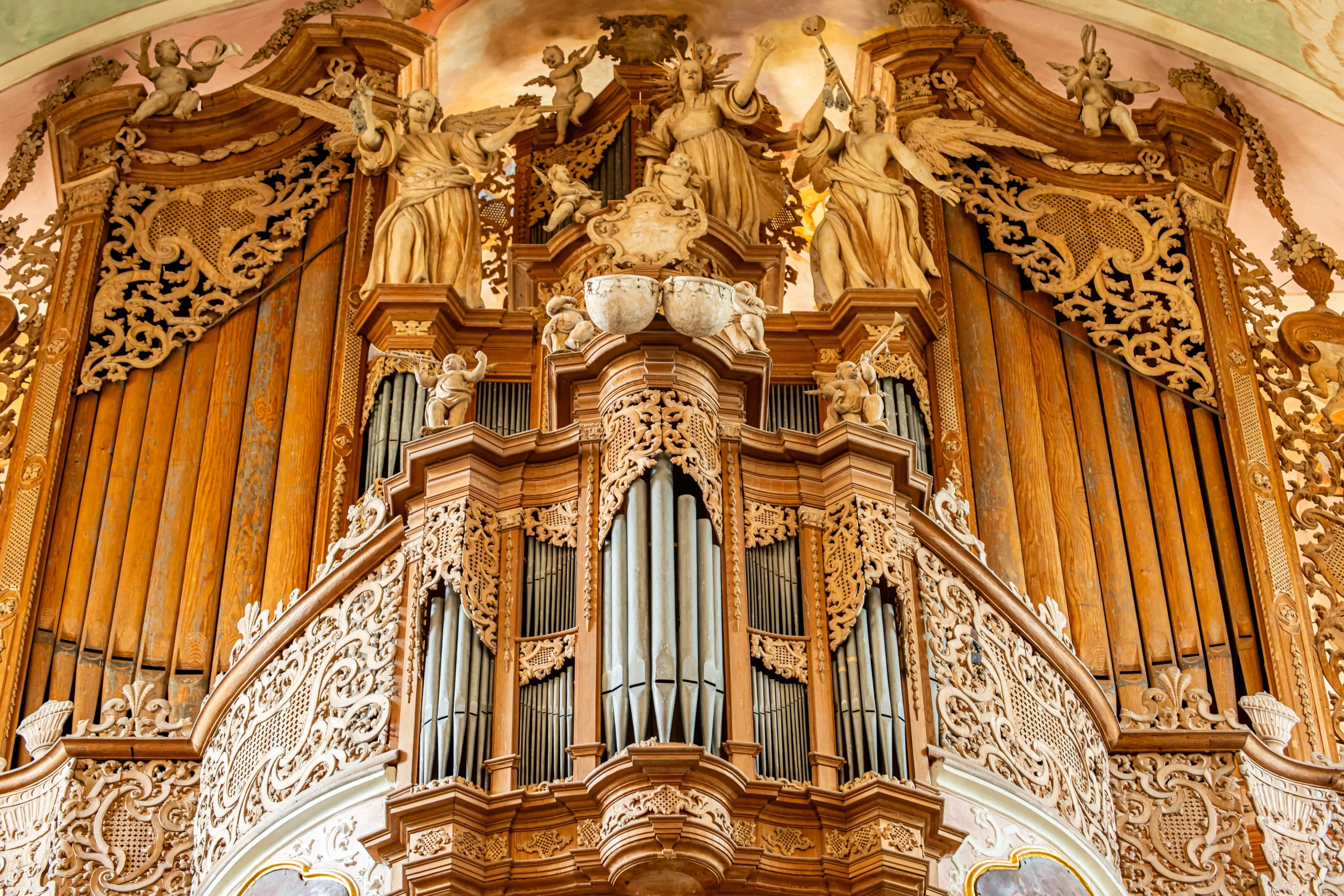
It commands attention from the far end of the nave—even when silent. The organ on the western gallery is at once an instrument, a work of architecture and a historical document. Johann Martin Baumeister of Eichstätt built it between 1734 and 1737. Monastery accounts recording payments to the organ builder now establish his authorship. That was not always understood: for a long time, the instrument was attributed to a builder from Dinkelsbühl.SourcesMichael Petzet (ed.) 1991, pp. 12–17Dr. Josef Hopfenzitz (ed.) 1991, pp. 33–49
Its history is held in accounts and conservation reports, but also in wood, metal, wind and sound. To understand it, you need to look beyond the pipes.
A name long forgotten
Johann Martin Baumeister was born at Hohenwart in 1692 and later worked from Eichstätt. His workshop belonged to a North Swabian and Franconian organ landscape whose craft connections crossed present-day regional boundaries. The Maihingen organ is his largest surviving work. Because so much historic fabric endured, it reveals a great deal about his construction and conception of sound.SourcesDr. Josef Hopfenzitz (ed.) 1991, pp. 18–42Michael Petzet (ed.) 1991, pp. 15–17
22 stops—and not a note to spare
Two manuals, pedal and 22 stops make up the instrument’s sound world: eleven stops in the Hauptwerk, seven in the Rückpositiv and four in the pedal. A surprise waits in the bass. Manuals and pedal have a short or “broken” octave. Not every chromatic note a modern player expects has its own key. This belongs to the instrument’s historic approach to compass and construction. The soundboards, action, console, bellows and wind system, and pipework are documented in detail in the specialist publications issued in 1991.SourcesDr. Josef Hopfenzitz 1995, pp. 19–21Dr. Josef Hopfenzitz (ed.) 1991, pp. 50–135
Hauptwerk, Rückpositiv and pedal are not three separate sound worlds. Principal, flute, string and compound stops work together, from a single colour to the full organ. The surviving specification contains no reed stops. Temperament and pitch also belong to the instrument’s material history; the specialist studies document their investigation and the decisions made during restoration.SourcesMichael Petzet (ed.) 1991, p. 16Dr. Josef Hopfenzitz (ed.) 1991, pp. 154–159, 188–200
A case like a stage
The case turns the multitude of pipes into a compelling composition. Its seven main sections combine a round tower, trapezoid towers and two-storey flats; the smaller Rückpositiv sits in the centre of the gallery front. Johann Melchior Hochstein’s workshop added carving, St Cecilia, music-making angels and putti. The wooden display pipes at the sides also played with appearances: tin foil once made them look like metal pipes. During restoration, the surviving remnants were conserved, but the lost covering was not recreated. The case retained its natural wood finish, while the figures and selected carvings were coloured.SourcesDr. Josef Hopfenzitz 2009, pp. 25–26Michael Petzet (ed.) 1991, pp. 48, 92–96
This organ is more than a piece of furniture. The main case, Rückpositiv and gallery front together form the church’s western end; the Friars’ choir behind the instrument was added later. Sixtus Lampl describes the organ’s dual effect: it shapes the space even in silence, while performance adds its acoustic presence.SourcesMichael Petzet (ed.) 1991, pp. 9, 11
Silence, unexpectedly, preserved it
After secularisation, the organ was used only irregularly and eventually fell silent for a long period. What first sounds like neglect had an unexpected consequence: it escaped the sweeping modernisations that fundamentally altered many historic organs. Maihingen’s instrument was not wholly untouched either. Its importance rests not on an imagined frozen original state, but on the exceptionally high proportion of historic structure and pipework that survived.SourcesMichael Petzet (ed.) 1991, pp. 12–17, 35–39Dr. Josef Hopfenzitz (ed.) 1991, pp. 43–49, 188–192
To restore is to decide
How do you make a centuries-old instrument sound again without turning it into a modern organ? Years of investigation and consultation preceded the answer. From 1988 to 1990, the Steinmeyer firm restored the organ with specialists in historic pipework. Soundboards, actions, console, bellows, wooden and metal pipes, case and temperament were among the elements examined and treated. The aim was to secure the inherited fabric and make its own tonal character audible again—not to build an all-purpose instrument behind a baroque façade.SourcesMichael Petzet (ed.) 1991, pp. 78–105, 109–127Dr. Josef Hopfenzitz (ed.) 1991, pp. 136–159
The restored organ was rededicated on Easter Monday, 1 April 1991. Two substantial publications issued that year recorded the findings, decisions and completed work. They document more than the outcome of the restoration: they have themselves become a chapter in the instrument’s history.SourcesDr. Josef Hopfenzitz 2009, p. 27Michael Petzet (ed.) 1991, pp. 78–127
A monument that has to sound
The German term Klangdenkmal—a monument in sound—can seem like a contradiction. A monument is meant to be preserved; an organ comes alive only in use. That is precisely what makes it special. Every act of maintenance touches historic fabric, but permanent silence would fail the instrument too. Care, scholarly rigour and music belong together here.
Next time you look at the case, imagine what happens behind it: keys set a mechanism in motion, air travels along historic paths, and 22 stops give the baroque space an ever-changing range of colours. The Friends support this connection between conservation, interpretation and music. Full scholarly references appear under Sources and literature.